Over the last few years Linkedin has been growing so I thought I would post my ideas on what I did to help my profile.
Make sure you have as much as you can within your profile filled out, such as:
1. Add a head shot
2. Summary (this can be your elevator speech)
3. Change your Public Profile link to something different
4. Add your Specialties (typically this is where the search engines look)
5. Under Experience you can list your jobs. At the very least always include a short statement of what the organization does and a bit on your accomplishments
6. Education
7. Join a few groups that interests you; you have 50 you can join (the more you join the more connections you will have)
8. Add any awards you have received
9. Add links to your blog or personal website
10. Get recommendations (if your references are on Linkedin contact them to ask them to write up a recommendation!)
11. You can also install different Widgets like what events you are attending, your travel schedule, books you are reading or even details on your recent blog posts, or install a widget to post the Word copy of your resume.
12. Add a keywords section to each of your jobs (this will help drive traffic to your profile).
Making Connections
1. Open up that contacts book or contacts in Outlook or Facebook and start to search to see if they are on Linkedin
2. If you go to networking events or meeting new clients and receive a business card, again, see if they are on Linkedin (also, in the invite write a personal message)
3. If you belong to smaller organizations review their member lists and see if they are on Linkedin
4. Do NOT post on group message boards that you are looking to make connections!
Driving traffic to your profile
1. Make sure you have all of the items listed in the first section above completed. This will help the search engines within Linkedin find you.
2. Search for yourself within linkedin using words you would think people may search on (select the town you are in currently to help narrow the search). If you show up in the first couple of pages you should start to see more hits. If not, it is time to add some more keywords to your profile.
3. If you visit message forums (on Linkedin or elsewhere) add a link to your Linkedin profile in your signature line
4. Add a link to your Linkedin profile to your email signature line
5. After you join some groups review some of their messages and if you find some interesting ones comment on it
6. Once you have some connections you can use the “What are you working on” section to help your connections know what you are up to or post a link to your latest blog post
Notable Quote:
Dan Schawbel
“In order to succeed in the new world of work you MUST become the commander of your career.”
Other useful links on this topic:
http://webworkerdaily.com/2007/06/15/20-ways-to-use-linkedin-productively/
http://blog.guykawasaki.com/2007/01/ten_ways_to_use.html
http://chris.pirillo.com/top-reasons-to-use-linkedin/
http://www.secretsofthejobhunt.com/video/how-to-use-linkedin-to-find
http://www.wordtracker.com/academy/guy-kawasaki-linkedin
http://www.katescoptur.com/katherine_scoptur/Blog/Entries/2009/2/23_My_Guide_to_LinkedIn,_Part_One.html
Saturday, May 02, 2009


Monday, April 20, 2009
SDLC humor
Over the years I have worked on or with many software development projects. Some have been smooth and some seem like they never wanted to end. Recently I Googled SDLC (software development life cycle) and one of the top links was a funny video on YouTube:
After this I found Timothy Trimble's Blog post on the SDLC process where he lays out what he thinks are some of the inital client questions to ask:
* Is this a new application need or a migration from an old application?
* What are the target platforms? (Mac, Win, Web, etc.)
* Will it be single or multi-user?
* Does it require a server based application/database?
* Is it to be a local or enterprise wide application? (Local site or multiple sites.)
* How soon does the client need the application delivered?
* Do you realistically have the resources for providing the application in the desired time frame?
* Does the application need to interface with other systems? (AS/400, Unix, etc.)
* Is there legacy data that has to be migrated to the new application, and what format is it in?
* Is the client interested in being involved with the testing of the application?
* Is training needed?
* Is documentation needed?
* Does the client require on-site development?
As with all projects, gathering the requirements is the most important thing, because we use this information to help set the timeline, budget and scope. Add more requirements later on and it may effect the timeline, budget and scope of the project.
Quote from Edward V. Berard:
"Walking on water and developing software from a specification are easy if both are frozen."
After this I found Timothy Trimble's Blog post on the SDLC process where he lays out what he thinks are some of the inital client questions to ask:
* Is this a new application need or a migration from an old application?
* What are the target platforms? (Mac, Win, Web, etc.)
* Will it be single or multi-user?
* Does it require a server based application/database?
* Is it to be a local or enterprise wide application? (Local site or multiple sites.)
* How soon does the client need the application delivered?
* Do you realistically have the resources for providing the application in the desired time frame?
* Does the application need to interface with other systems? (AS/400, Unix, etc.)
* Is there legacy data that has to be migrated to the new application, and what format is it in?
* Is the client interested in being involved with the testing of the application?
* Is training needed?
* Is documentation needed?
* Does the client require on-site development?
As with all projects, gathering the requirements is the most important thing, because we use this information to help set the timeline, budget and scope. Add more requirements later on and it may effect the timeline, budget and scope of the project.
Quote from Edward V. Berard:
"Walking on water and developing software from a specification are easy if both are frozen."
Sunday, April 12, 2009
Personal Branding…
Personal branding seems like it is the latest web phenomenon. As communication changes more are moving to personal branding because they realize that when applying for jobs, web content will give them the step up than just a simple cover letter and resume and it also can work as a networking tool.
My personal branding story started back in 1996 when I was in college looking for a summer internship. At that time I built a 1 page website on geocities (hey! it was free) with a head-shot, 4 paragraphs about me, a link to my resume, a link to my email address and a link to some photos. At the time I always included my web address on the top of my resume. I registered the site on Yahoo! and monitored the search on my name to make sure my site was always towards the top of the first page.
Now about a year ago, I went to the next step. I created a normal multiple page website, purchased ryanendres.com; started a blog on Project Management; joined Linkedin (I think I joined that about 5 yrs ago) and have come up with some creative ways to try to drive traffic to my blog (like add a link to it in my signature line on message forums).
Since I have created this I was found (by way of The Google) by a group setting up a talk on PMOs (Project Management Offices) and they asked me to come give a presentation on setting up a PMO that makes sense for your organization.
My next step was to add some press articles that I have been featured in. My first one came out this past month (I was selected for Madison's WI top 40 under the age of 40 for 2009 by InBusiness magazine).
The days of the paper resume are numbered....
Tips on How to create your own personal brand:
1. Create a Linkedin account (and join other social networking sites; twitter, facebook…); and then build your network of “friends”.
2. Create a webpage about yourself
3. Create a blog. This is the most important one. If you keep your blog to 1 topic you will show the world that you are passionate about what you do! Also, by adding more info to it you will increase your chance to be seen. Companies like alice.com are jumping on the company blogging idea too. Alice.com has 1 full time person dedicated to the social media aspect of their website.
4. Read and comment on other blogs and message forums and have a signature line to promote yourself.
5. Set up an alert on your name (assuming your name is not a common one) so you know when something about you has been added to the web: http://www.google.com/alerts
6. Use your status updates in facebook, twitter, linkedin to let your followers know you have a new blog post (shorten the link with: http://tr.im), or that you are keeping your eyes open for new opportunities (... is looking for new opportunities at a PMO in Madison).
Notable Quote:
Dan Schwabel
“Life is one big pitch, so you better start practicing.”
Links:
http://personalbrandingblog.com/you-dont-need-to-be-an-expert-to-build-your-personal-brand/
http://www.brazencareerist.com/career-blogging/Career_Blogging_Ryan_Healy_Brazen_Careerist.pdf
Great new book on Personal Branding:
http://www.amazon.com/Me-2-0-Powerful-Achieve-Success/dp/1427798206
http://everything.typepad.com/blog/2009/03/how-a-blog-can-help-your-job-search.html
http://mashable.com/2009/02/05/personal-branding-101/
http://www.collectiblescornertv.com/7-ways-to-convince-people-youre-an-expert-even-your-mother-should-know/
http://www.nytimes.com/2009/03/28/your-money/28shortcuts.html?_r=3&ref=business
http://www.jer979.com/igniting-the-revolution/brandintro/
My personal branding story started back in 1996 when I was in college looking for a summer internship. At that time I built a 1 page website on geocities (hey! it was free) with a head-shot, 4 paragraphs about me, a link to my resume, a link to my email address and a link to some photos. At the time I always included my web address on the top of my resume. I registered the site on Yahoo! and monitored the search on my name to make sure my site was always towards the top of the first page.
Now about a year ago, I went to the next step. I created a normal multiple page website, purchased ryanendres.com; started a blog on Project Management; joined Linkedin (I think I joined that about 5 yrs ago) and have come up with some creative ways to try to drive traffic to my blog (like add a link to it in my signature line on message forums).
Since I have created this I was found (by way of The Google) by a group setting up a talk on PMOs (Project Management Offices) and they asked me to come give a presentation on setting up a PMO that makes sense for your organization.
My next step was to add some press articles that I have been featured in. My first one came out this past month (I was selected for Madison's WI top 40 under the age of 40 for 2009 by InBusiness magazine).
The days of the paper resume are numbered....
Tips on How to create your own personal brand:
1. Create a Linkedin account (and join other social networking sites; twitter, facebook…); and then build your network of “friends”.
2. Create a webpage about yourself
3. Create a blog. This is the most important one. If you keep your blog to 1 topic you will show the world that you are passionate about what you do! Also, by adding more info to it you will increase your chance to be seen. Companies like alice.com are jumping on the company blogging idea too. Alice.com has 1 full time person dedicated to the social media aspect of their website.
4. Read and comment on other blogs and message forums and have a signature line to promote yourself.
5. Set up an alert on your name (assuming your name is not a common one) so you know when something about you has been added to the web: http://www.google.com/alerts
6. Use your status updates in facebook, twitter, linkedin to let your followers know you have a new blog post (shorten the link with: http://tr.im), or that you are keeping your eyes open for new opportunities (... is looking for new opportunities at a PMO in Madison).
Notable Quote:
Dan Schwabel
“Life is one big pitch, so you better start practicing.”
Links:
http://personalbrandingblog.com/you-dont-need-to-be-an-expert-to-build-your-personal-brand/
http://www.brazencareerist.com/career-blogging/Career_Blogging_Ryan_Healy_Brazen_Careerist.pdf
Great new book on Personal Branding:
http://www.amazon.com/Me-2-0-Powerful-Achieve-Success/dp/1427798206
http://everything.typepad.com/blog/2009/03/how-a-blog-can-help-your-job-search.html
http://mashable.com/2009/02/05/personal-branding-101/
http://www.collectiblescornertv.com/7-ways-to-convince-people-youre-an-expert-even-your-mother-should-know/
http://www.nytimes.com/2009/03/28/your-money/28shortcuts.html?_r=3&ref=business
http://www.jer979.com/igniting-the-revolution/brandintro/
Tuesday, March 10, 2009
Lesson Learned Questions
Question. When do you complete lessons learned during your project? At the end right? Well, yes that is part of it, but there may be some other logical time points to consider too.
If your project is set up with phases, it may be a good idea to have a lessons learned meeting at the end of each phase (why wait until the end of a 3 year project, when there are some valuable lessons at the end of phase 1). Also, if there is a major event that occurs (good or bad) it is important to get the info out so other PMs know that it may affect them.
So what questions do you ask at a lessons learned meeting? There are some classic ones that I will cover below, but there are always some questions that are project or organization specific.
Questions:
- How was the communication of project details? Any suggestions for improvement? (remember 90% of being a PM is communication! If communication is lacking in your projects you need to fix it).
- What issues occurred and how did we fix them? (if you keep an issues table for the life of your project this will be easy to review at the meeting)
- Recommendations for future projects like this one.
- Input from the team on the Project Management process.
- Did we have enough resources? Remember we planned that timeline at the beginning and resource managers signed off on the project...
- What workarounds did you use? Did they work? This is important to document, since you may need to use this workaround on a future project.
- What went well? We want to document this so we make sure we do this again, or review it to do it even better next time!
- Did the scope change during this period, if so why? Remember if you change the scope it may affect other things (like time, budget, resources)
If you have issues with team members opening up I suggest creating a survey (see my post on lesson learned surveys).
Finally, you need a common location for your lessons learned findings. In my organization, we send the lessons learned document around for review to the Executives and the PMs. And then these are stored in a common location for future review. Without lessons learned your PMO or PM process will never have a chance to improve.
Notable quotable from the movie Animal House (from the blog: uncoachable.com):
Bluto: Over? Did you say “over”? Nothing is over until we decide it is! Was it over when the Germans bombed
Otter: Germans?
Boon: Forget it, he’s rolling.
Bluto: And it ain’t over now. ‘Cause when the goin’ gets tough…
[thinks hard]
Bluto: the tough get goin’! Who’s with me? Let’s go!
[runs out, alone; then returns]
Bluto: What the **** happened to the Delta I used to know? Where’s the spirit? Where’s the guts, huh? This could be the greatest night of our lives, but you’re gonna let it be the worst. “Ooh, we’re afraid to go with you Bluto, we might get in trouble.” Well just kiss my ass from now on! Not me! I’m not gonna take this. Wormer, he’s a dead man! Marmalard, dead! Niedermeyer…
Otter: Dead! Bluto’s right. Psychotic, but absolutely right. We gotta take these bastards. Now we could do it with conventional weapons that could take years and cost millions of lives. No, I think we have to go all out. I think that this situation absolutely requires a really futile and stupid gesture be done on somebody’s part.
Bluto: We’re just the guys to do it.
D-Day: Let’s do it.
Bluto: *Let’s do it*!
Lesson Learned: Don’t ever give up
Friday, February 13, 2009
Awareness of Cultural Differences
Several years ago I traveled to Nagoya Japan for a start-up meeting. I was fortunate on this trip because 2 other co-workers were also allowed to attend.
Prior to my travels I consulted my co-workers, who have traveled to Japan before, about any cultural differences I should be aware of so I didn’t offend our clients with my “American Ways”.
- When you receive a business card, hold onto it with 2 hands and really inspect it.
- Prior to the gathering exchange gifts (with your counterpart), but do not do it in front of everyone.
- If giving a presentation do not have jokes, because they may not translate well.
- At the end of your presentation, typically they will not have any questions, but they will confront you later on, one on one (so make sure you offer one on one time).
- Talk with them about their country's history and if you have some free time ask them for suggestions on historic places to visit.
"I note the obvious differences between each sort and type, but we are more alike, my friends, than we are unalike."
~Maya Angelou
Osu Kannon Temple, Nagoya, Japan


Thursday, January 29, 2009
Project Management Manual…
I have received several emails requests about my PMO talk that I gave in November. You can find a pdf here of the presentation. I’ll write about page #15 below:
As your organization grows and learns to accept that projects need to be structured you need to make sure your staff understands what that structure is when they are running their projects.
Many organizations that reach this level have 2 types of projects. Small ones and big ones. What is small and what is big? It depends on your organization. You may choose a dollar amount to define them, or a project ranking system or some other means that fits your organization.
So what is in this manual?
The manual should detail the steps of the project from the beginning (like a method to review and accept new projects, so it stops the projects coming in the back door) to the end (how about a standard project close-out check list) and the forms and templates the PM must use to run the project. These forms and templates typically are specific to your organization.
Why standardize this process? Well, it will allow your PMs and team members to see one consistent way of managing projects. Also, your staff will spend less time fighting fires and it will limit things from slipping through the cracks.
Once you have this in place you can move on to the next phase which is auditing your PMs to make sure they are using your predefined methodology.
Notable Quotable:
“Successful firms have mastered the art of melding the power of human will and organization. But the key to their vitality is their world class capabilities in selecting, guiding, and completing development projects, which are the building blocks of renewal and change. The companies that can repeat this process again and again have discovered the manufacturer’s perpetual motion machine”
Bowen, H. Kent, Clark, Kim B., Holloway, Charles A., Wheelwright, Steven C., The Perpetual Enterprise Machine, page 14 Oxford University Press, Inc. New York, NY., 1994.
Friday, January 23, 2009
Speed Networking…
As the economy slows down and reports coming out every day about companies cutting jobs it may be time to dust off that rolodex and look for some new contacts to put into it.
This past week I attended a local (Madison, WI) speed networking event (about 100 attended). Chairs were set up in U shape and attendees had 3 minutes to talk before the whistle blew and you move on to the next person.
I have attended these in the past and every time I make some great new connections. If you are planning on attending a speed networking event keep the following in mind:
1. Have your 30 second elevator speech ready. Treat it like an interview. Start with a hand shake and end with a hand shake. Sit up straight and give lots of eye contact to the person you are speaking with.
2. Have follow up questions ready to roll! Are you from the area? What are your hobbies? How did you find your current job?
3. If you receive a business card follow up with an email to them several days after the event. Review Linkedin.com to see if they are a member and ask them to join your network.
If you have never attended a speed networking event before I highly recommend it, because you never know who might be able to help you or how you can help someone else out in the future.
Good Blog post on Networking...
Sunday, January 04, 2009
Successful Organizations...
This past month I attended a book discussion put on by MAGNET
and we discussed the book
Good to Great: Why Some Companies Make the Leap... and Others Don't by Jim Collins
The event was intended for people who have read all of the book, some of the book, or even none of the book. Feedback was mixed from those that read it since some of the companies mentioned as great companies are now gone, or bankrupt or are receiving bailout money. Many that read it were looking for what companies did to move from good to great, but the book doesn’t detail it. That being said I didn’t feel the need to run out and purchase the book.
Recently, I purchased the book 301 ways to have fun at work by Dave Hemsath and Leslie Yerkes.
The book is broken down into 6 parts: Work Environment, Communication, Training, Meetings, Recognition and Team Building. The book was written in 1996, and certain parts of it are dated, but it has spurred a few ideas for me to try in my current organization and helped me remember some things I have experienced at a previous organization….
At a previous organization we had just been bought out and rumors started flying about pink-slips. Our site director then started to write up a newsletter to keep everyone updated on what was happening. As weeks turned into months the site director asked each department to come up with skits. Every 2 weeks a department would give a skit to the entire organization. This helped everyone focus on some fun for a short time instead of uncertainty. We also had BINGO over the PA; reading numbers at 10AM and 2PM. Yell out BINGO and win a gift card to a local restaurant.
Then the ball dropped. Pink-slips for everyone, but not for two months! So our future was set, but we needed to transition our knowledge to the new buyers. At this time there was still one department left to complete their skit (which was suppose to happen the day the bad news came out) and that was the Project Management department.
After this event we did a complete re-write of our script and presented it a couple weeks later. We went with Saturday Night Live skits (The Church Lady, Wayne’s World, and Weekend Update). The skit was a huge success and everyone had a great time.
One final hurrah! Our last day ended with a pig roast at a local outdoor brewery and everyone received custom made trophies using 1 part of our medical delivery device we created. I still have this in my office today to reflect on that part of my past.
Notable Quote
Humor consultant and bestselling author C.W. Metcalf wrote in HR Focus (February 1993) that, “humor is a vital, critical element for human survival, and we often forget about it, and set it aside. We are told that laughter, fun, and play are unadult, unintelligent, and nonprofessional. Nothing could be further from the truth. One of the first indicators of the onset of most mental illness is a loss of the sense of joy in being alive.”
and we discussed the book
Good to Great: Why Some Companies Make the Leap... and Others Don't by Jim Collins
The event was intended for people who have read all of the book, some of the book, or even none of the book. Feedback was mixed from those that read it since some of the companies mentioned as great companies are now gone, or bankrupt or are receiving bailout money. Many that read it were looking for what companies did to move from good to great, but the book doesn’t detail it. That being said I didn’t feel the need to run out and purchase the book.
Recently, I purchased the book 301 ways to have fun at work by Dave Hemsath and Leslie Yerkes.
The book is broken down into 6 parts: Work Environment, Communication, Training, Meetings, Recognition and Team Building. The book was written in 1996, and certain parts of it are dated, but it has spurred a few ideas for me to try in my current organization and helped me remember some things I have experienced at a previous organization….
At a previous organization we had just been bought out and rumors started flying about pink-slips. Our site director then started to write up a newsletter to keep everyone updated on what was happening. As weeks turned into months the site director asked each department to come up with skits. Every 2 weeks a department would give a skit to the entire organization. This helped everyone focus on some fun for a short time instead of uncertainty. We also had BINGO over the PA; reading numbers at 10AM and 2PM. Yell out BINGO and win a gift card to a local restaurant.
Then the ball dropped. Pink-slips for everyone, but not for two months! So our future was set, but we needed to transition our knowledge to the new buyers. At this time there was still one department left to complete their skit (which was suppose to happen the day the bad news came out) and that was the Project Management department.
After this event we did a complete re-write of our script and presented it a couple weeks later. We went with Saturday Night Live skits (The Church Lady, Wayne’s World, and Weekend Update). The skit was a huge success and everyone had a great time.
One final hurrah! Our last day ended with a pig roast at a local outdoor brewery and everyone received custom made trophies using 1 part of our medical delivery device we created. I still have this in my office today to reflect on that part of my past.
Notable Quote
Humor consultant and bestselling author C.W. Metcalf wrote in HR Focus (February 1993) that, “humor is a vital, critical element for human survival, and we often forget about it, and set it aside. We are told that laughter, fun, and play are unadult, unintelligent, and nonprofessional. Nothing could be further from the truth. One of the first indicators of the onset of most mental illness is a loss of the sense of joy in being alive.”
Sunday, November 16, 2008
A presentation on PMO's...
This past week I gave a presentation titled: Building a PMO that makes sense to your organization, at the UW E-Business Consortium to the IT Executives Circle Peer Group.
Link to my presentation
The discussion of the day was PMO's. Many folks vented their frustrations of trying to start up PMO's including making sure their projects had resources available to complete the project.
The second speaker, Dave Webb from Alliant Engergy, talked about the metrics they were using to track their projects, along with the concept of reviewing the PM's who run their projects. I thought this was an interesting concept sense I currently will perodically audit certain aspects of our project management processes within my own organization. The end result of the Alliant PM review is a numerical rating of the PM. If it is too low then the PMO may have to work with the PM in the areas they are laking. Definitely an interesting concept to consider for my own PMO in the future.
The day after this talk I listened to the most recent PM podcast Episode 108: How Peer Reviews will Keep You Honest and Your Project on Track.
Again, listening to this really helped to drive home the importance of the PMO to review their PM's to make sure they are using the correct project mananagement processes that are laid out by the PMO.
Link to my presentation
The discussion of the day was PMO's. Many folks vented their frustrations of trying to start up PMO's including making sure their projects had resources available to complete the project.
The second speaker, Dave Webb from Alliant Engergy, talked about the metrics they were using to track their projects, along with the concept of reviewing the PM's who run their projects. I thought this was an interesting concept sense I currently will perodically audit certain aspects of our project management processes within my own organization. The end result of the Alliant PM review is a numerical rating of the PM. If it is too low then the PMO may have to work with the PM in the areas they are laking. Definitely an interesting concept to consider for my own PMO in the future.
The day after this talk I listened to the most recent PM podcast Episode 108: How Peer Reviews will Keep You Honest and Your Project on Track.
Again, listening to this really helped to drive home the importance of the PMO to review their PM's to make sure they are using the correct project mananagement processes that are laid out by the PMO.
Friday, August 22, 2008
Networking...
Networking is an important part of career development. Think about it for a minute. Have you or someone you know of received a job because they know someone at the company? Many companies now favor this since it gives them an opportunity to hear a bit more about the person then what is written in their cover letter and resume.
There are many ways to put yourself into networking environments. Many times if you are a member in different societies (example: Project Management Institute) you will have that opportunity to socialize and network with others.
When you find yourself in this environment keep the following in mind:
1. Have that 30 second commercial about yourself ready to go when they ask you, “what do you do?”
2. Have business cards ready to hand out and if you receive one make sure you follow up with the person via email several days after the event.
3. Be ready to small talk and always follow up with a question to the person you are speaking with.
4. Try to attend different events in your community or you may find that you are attending the same meetings and meeting the same people.
Also, there is a new type of social networking on the internet. LinkedIn, is one example of this. LinkedIn is a professional networking site where you can reconnection with old colleagues and friends to see what they are up to professionally. Another example is Facebook. Facebook (90 million users) primarily draws in the Gen-Y and Gen-X crowd and it allows them to easily reconnect with old colleagues, high school and college friends and others associated with the same organizations. It also allows you to post photos and videos to let your “friends” know what you are up to.
Just like project management, networking has changed over the years. We must embrace the changes and find out what works for our organizations and for us personally.
Photo: Networking event with MAGNET (Madison’s Next Generation of Leaders) at the Governors’ Mansion 20Aug2008.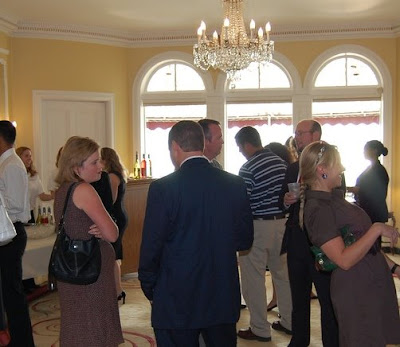
There are many ways to put yourself into networking environments. Many times if you are a member in different societies (example: Project Management Institute) you will have that opportunity to socialize and network with others.
When you find yourself in this environment keep the following in mind:
1. Have that 30 second commercial about yourself ready to go when they ask you, “what do you do?”
2. Have business cards ready to hand out and if you receive one make sure you follow up with the person via email several days after the event.
3. Be ready to small talk and always follow up with a question to the person you are speaking with.
4. Try to attend different events in your community or you may find that you are attending the same meetings and meeting the same people.
Also, there is a new type of social networking on the internet. LinkedIn, is one example of this. LinkedIn is a professional networking site where you can reconnection with old colleagues and friends to see what they are up to professionally. Another example is Facebook. Facebook (90 million users) primarily draws in the Gen-Y and Gen-X crowd and it allows them to easily reconnect with old colleagues, high school and college friends and others associated with the same organizations. It also allows you to post photos and videos to let your “friends” know what you are up to.
Just like project management, networking has changed over the years. We must embrace the changes and find out what works for our organizations and for us personally.
Photo: Networking event with MAGNET (Madison’s Next Generation of Leaders) at the Governors’ Mansion 20Aug2008.

Thursday, July 31, 2008
The PM traveling tool box….
During a recent trip to
- Highlight the key pieces of information on your flight (times, codes, flight numbers). This will help you to see those key things at a glance.
- Make sure you have the hotel and airline phone numbers. Why stand in a long line after a canceled flight when you can call in to make the changes.
- Make copies of your credit cards and passport (and you hotel and flight plan). Keep one copy for yourself and hand off a second to a loved one (in my case my wife). That way if you lose something some else has a copy or if the holder needs to they can try to track them down.
- Make sure you spend a little You time during your trip. If you don’t have the time to research something to do outside your hotel, speak with your concierge at your hotel.
- Pack yourself a couple of candy bars or ganola bars. This will help to get through those long lay overs or delayed flights.
- Bring your digital camera and laptop. At night email a couple of pictures to family and friends.
Finally don’t forget to relax and enjoy!
The photos are of Duomo Church in Milan Italy; the first stones were laid in 1296:


Tuesday, June 24, 2008
The start-up meeting and The Presentation...
This past week I flew out to the west coast to meet up with 60 team members from 20 locations for a start-up meeting. At this meeting there were several Project Managers who presented their parts of the project to the team members. This face to face meeting was great to finally meet several of the key team members I have been working with over the past few months to set the project up.
I was also asked to give a 45 minute presentation on my section of the project. I have and continue to enjoy getting up in front of people to convey a message to the masses. When I give presentations I always do a few key things that help me shine (if I can toot my own horn).
1. Lay out the different sections of your presentation within the 1st couple of slides so the audience knows what to expect.
2. Get the audience involved at the beginning, middle and end. How? Come up with some basic questions and ask for a raise of hands; at the end ask questions to the audience on some key points you emphasized during your presentation (this will help cover this point one last time).
3. Don't just read your slides! If all you do is read your slides your audience will fall asleep since they can just read them themselves!
4. If you show hands on items in your slides think about having a table set up to allow the attendees to view/handle these items during your meeting breaks. During this time be at the table to answer any questions.
5. Use your hands, face and vocal tones to keep your audience interested. No one is interested in a mono-tone frozen speaker.
6. If others are presenting similar parts, name drop ("I will briefly cover this topic, but after lunch Bob will give a more in-dept talk about this").
7. Be confident in yourself. If you walk in with confidence your audience will see that in your talk and the first jitters will be short because you can feel the positive vibe from the audience.
8. Have a brief closing statement and emphasize, "that we are all a team and we will all work together to make this project happen"
Sunrise from my hotel room (Looks like another great start for a new project):

I was also asked to give a 45 minute presentation on my section of the project. I have and continue to enjoy getting up in front of people to convey a message to the masses. When I give presentations I always do a few key things that help me shine (if I can toot my own horn).
1. Lay out the different sections of your presentation within the 1st couple of slides so the audience knows what to expect.
2. Get the audience involved at the beginning, middle and end. How? Come up with some basic questions and ask for a raise of hands; at the end ask questions to the audience on some key points you emphasized during your presentation (this will help cover this point one last time).
3. Don't just read your slides! If all you do is read your slides your audience will fall asleep since they can just read them themselves!
4. If you show hands on items in your slides think about having a table set up to allow the attendees to view/handle these items during your meeting breaks. During this time be at the table to answer any questions.
5. Use your hands, face and vocal tones to keep your audience interested. No one is interested in a mono-tone frozen speaker.
6. If others are presenting similar parts, name drop ("I will briefly cover this topic, but after lunch Bob will give a more in-dept talk about this").
7. Be confident in yourself. If you walk in with confidence your audience will see that in your talk and the first jitters will be short because you can feel the positive vibe from the audience.
8. Have a brief closing statement and emphasize, "that we are all a team and we will all work together to make this project happen"
Sunrise from my hotel room (Looks like another great start for a new project):

Sunday, May 18, 2008
Team Building...
Team building is a necessary part of every project. Whether it is team building activity during a meeting or getting the team together to do something at an outside event. Many times team building events help your team to refocus on the project.
This past week I organized a hot dog social for my team. The event allowed everyone on the team to come together to talk about things other then the project and leave with a full tummy and ready to keep the project moving on!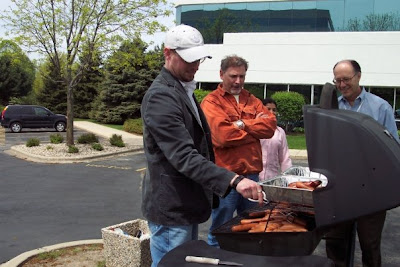
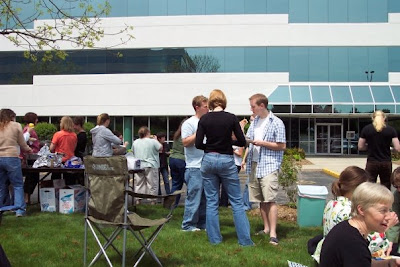
This past week I organized a hot dog social for my team. The event allowed everyone on the team to come together to talk about things other then the project and leave with a full tummy and ready to keep the project moving on!


Sunday, May 11, 2008
Custom Cars and Project Management
Several weeks ago I was contacted by an automotive instructor at MATC (Madison Area Technical College) about bringing my car in for an automotive career day they were having. I agreed to bring my car in and also at the same time pass on some Project Management knowledge to the ~ 300 high school kids that showed up for the day.

My car, a 1958 Volkswagen Beetle:
During the day many students ask me about my car and what I did for a living. I explained to them that I was a PM and many of the skills I have could be transferred to managing the build up of custom cars or restoring cars. The car hobby in recent years has been popularized by TV shows such as Unique Whips, American Chopper and American Hot Rod. All of these shows have one thing in common. And that is project management of their builds. There is a charter which assigns the project need and a PM, a WBS which is typically a checklist, stakeholders and a timeline. It is then the PM's job to keep the team members on task and motivative.
After I used this analogy the high school kids better understood what I do and many of them commented that they would love to manage a project of building a custom car or motorcycle.
Plant the seed and maybe it will grow...

My car, a 1958 Volkswagen Beetle:
During the day many students ask me about my car and what I did for a living. I explained to them that I was a PM and many of the skills I have could be transferred to managing the build up of custom cars or restoring cars. The car hobby in recent years has been popularized by TV shows such as Unique Whips, American Chopper and American Hot Rod. All of these shows have one thing in common. And that is project management of their builds. There is a charter which assigns the project need and a PM, a WBS which is typically a checklist, stakeholders and a timeline. It is then the PM's job to keep the team members on task and motivative.
After I used this analogy the high school kids better understood what I do and many of them commented that they would love to manage a project of building a custom car or motorcycle.
Plant the seed and maybe it will grow...
Saturday, May 03, 2008
PMI Madison Professional Development Day
A few weeks ago I attended the Madison PMI Professional Development Day at the Monona Terrace. I attended several talks on PMOs and one person's talk which hit home for me was Kevin Zerman from Miller Brewing Company. He said that an effective PM is not a person who can live and breath the PMBOK, but is rather a person who understands project management and has the right soft skills to lead the team.
Soft Skills
Over the years I have observed how important it is to be a leader of the pack to be an effective PM. During this same day I also attended a talk by Buck Joseph who is a professor at UW Madison. I have seen Buck speak several times over the years and I feel enlighten every time and I enjoy watching him as he works the crowd. Buck is able to make you see just how important soft skills are (don't forget to smile). From the way you dress, speak, listen, motivate people and even your mannerisms. Buck laid it out as: CHARCOAL:
Soft Skills
Over the years I have observed how important it is to be a leader of the pack to be an effective PM. During this same day I also attended a talk by Buck Joseph who is a professor at UW Madison. I have seen Buck speak several times over the years and I feel enlighten every time and I enjoy watching him as he works the crowd. Buck is able to make you see just how important soft skills are (don't forget to smile). From the way you dress, speak, listen, motivate people and even your mannerisms. Buck laid it out as: CHARCOAL:
Confidence, Honesty, Approachability, Reciprocity, Consistency, Openness, Acceptance, Likeability
Subscribe to:
Posts (Atom)